Abstract
Combined heat and power (CHP) plants are increasingly promoted as a key technology for the energy transition because they repurpose waste heat and improve efficiency. Yet CHP plants may be disproportionately vulnerable to climate change.
Using operational data from 390 Chinese thermal power units (2019–2022), we estimate the effect of temperature on plant efficiency and separate supply-side from demand-side mechanisms.
We find that an additional day above 30°C reduces monthly efficiency by 0.266 percentage points (pp) for CHP units, compared to only 0.018 pp for conventional units. Roughly 70% of CHP efficiency losses stem from declining heating demand.
Projections using climate scenarios suggest that by the 2050s, CHP efficiency could fall by 2.08 pp, lowering annual revenues by US$6.4–8.9 billion and raising CO₂ emissions by 33–45 million tons.
These findings highlight a paradox: while CHP plants are often promoted as efficient solutions for decarbonization, they are highly exposed to climate risks. Integrating climate considerations into CHP investment and retirement strategies is therefore critical for global energy policy.
Speaker
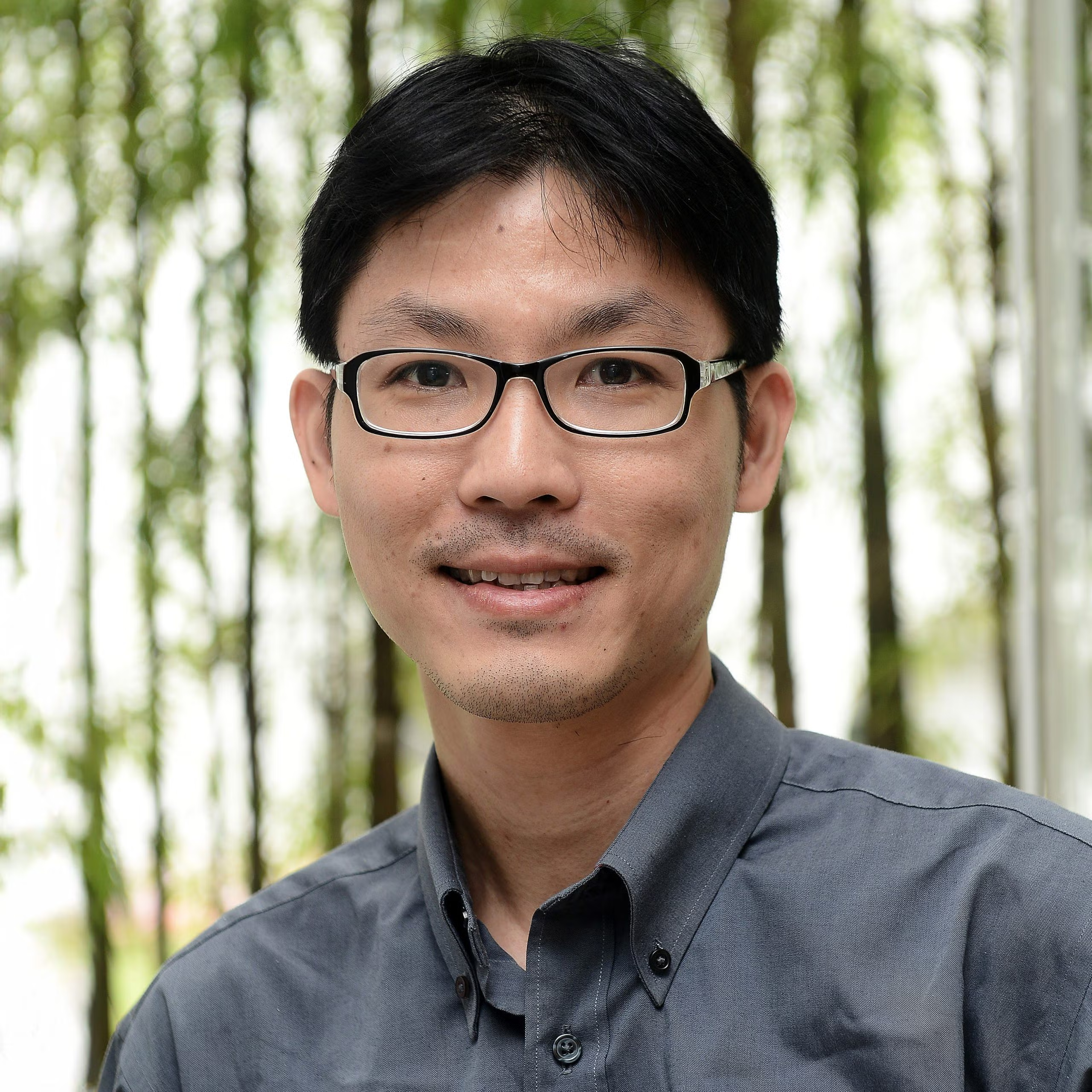
Jie-Sheng Tan-Soo
Jie-Sheng Tan-Soo is an Assistant Professor at the Lee Kuan Yew School of Public Policy, and Director at the Institute for Environment and Sustainability. He received his PhD in Environmental Economics and Policy from Duke University.
His research interests are broadly at the intersection of environment, health, and development. Some of the topics he has worked on include indoor air pollution from the use of biomass fuels and inefficient stoves, industrial pollution in China, air quality valuation, impact evaluation of water and sanitation interventions, and ecosystem services provided by tropical forests.
While these topics are interdisciplinary, he primarily uses microeconometric techniques in combination with economic modeling to conduct empirical research.
His research has been published in journals such as Nature Climate Change, Nature Communications, Proceedings of the National Academy of Sciences, Journal of the Association of Environmental and Resource Economists, and Journal of Development Economics.
Discussant

Da Zhang
Dr. Da Zhang is an associate professor (with tenure) at Tsinghua University. His research focuses on energy and climate legislation and policymaking in China.
He has been providing recommendations to the National People’s Congress, the People’s Bank of China, the Ministry of Finance, the Ministry of Ecology and Environment, the National Development and Reform Commission, the Ministry of Science and Technology, the State-Owned Assets Supervision and Administration Commission, and the National Energy Administration.
His work has appeared in American Economic Journal: Economic Policy, Energy & Environmental Science, Joule, Journal of Environmental Economics and Management, The Lancet Planetary Health, Nature Climate Change, Nature Energy, One Earth, and PNAS.
He has also led research grants sponsored by the United Nations Economic and Social Commission for Asia and the Pacific, the World Bank, the Asian Development Bank, and the International Energy Agency.
He is a coordinating lead author (CLA) for the Intergovernmental Panel on Climate Change (IPCC) Seventh Assessment Report (AR7).